
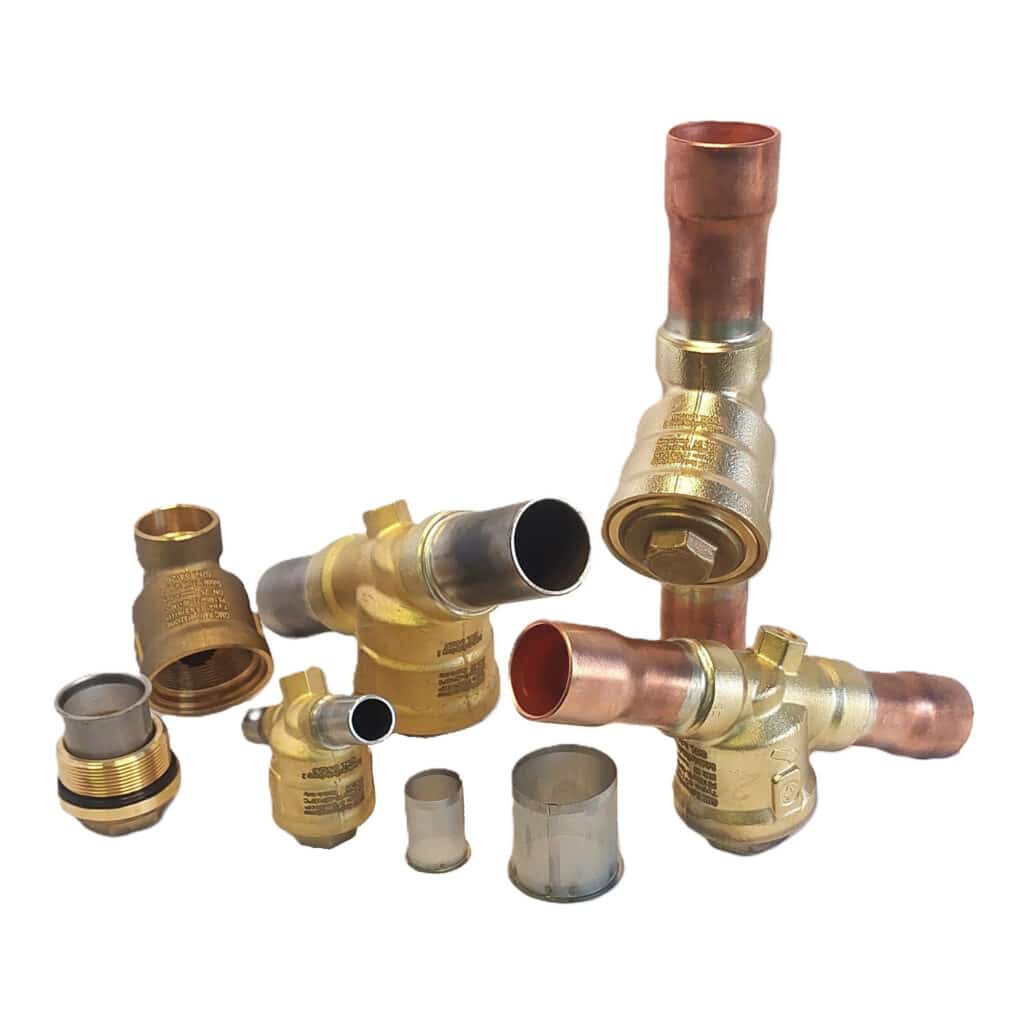
Inspectable filter strainers are considered “Pressure Accessories” as defined in Article 2, paragraph 5, of Directive PED 2014/68/EU. The whole series has been designed for the use of refrigerant R744 (CO2), classified by Article 13, paragraph 1, letter (b), of Directive PED 2014/68/EU as belonging to Group 2, or non-toxic fluid, non-flammable and non-explosive and listed in Appendix E to EN 378-1 as belonging to Group A1.
In the case of inspectable filters, the internal Nominal Dimensions (DN), foreseen now, vary from diameters of 16 mm for the smallest, up to diameters of 31 mm for the largest versions, while the maximum operating pressures, indicated in the reference tables, do not exceed 140 bars for all models. According to Table 7 of Annex II of Directive 2014/68/ EU, all these products now fall under the scope of Article 4.3.
In all inspectable filters, the body and the cap are made of forged brass UNI EN12420 – CW617N. In the series IYS2 HP connection pockets are made directly into the body and can accommodate, depending on the model, both metric tubes, typically stainless steel, and inch tubes, typically CuFe2P.
In the IYS4 series the connections of the HP line are made of stainless-steel tubes, while for the K line they are made of copper CuFe2P alloy. The filter element consists of a cylinder in AISI 304L micro-stretched sheet metal that is removable for cleaning; its large filtering surface allows to lengthen the time between one maintenance and the next thus preserving a high value of Kv over time. The seal between the body and the cap is entrusted to an EPDM seal.
The inspectable filter strainers of this series can be installed, with the longitudinal axis arranged both horizontally and vertically, provided that the cap is always facing down to ensure that the filtered impurities in the system remain by gravity confined to the bottom of the filter element and collected in the removable cap even in the absence of flow – then strictly observe the installation instructions on the instruction sheet attached to the product or downloadable from the site.
It is also necessary to provide in the installation that there is enough space to unscrew and completely extract the filter element together with the cap. Where there is vibration, appropriate damping and fixing systems should be provided to avoid overloading welds/brazes and connections.